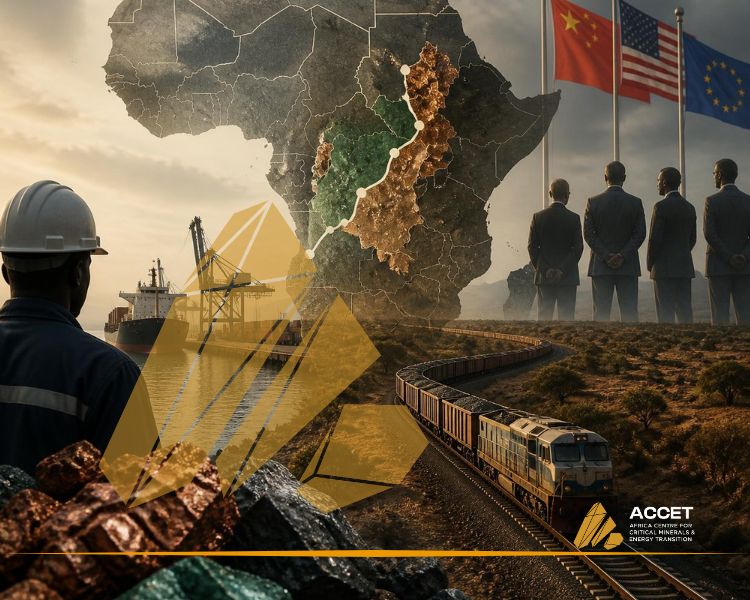

Africa is once again at the centre of a global resource race. From cobalt and lithium to graphite, manganese and rare earths, the minerals beneath its soil are essential to electric vehicles, renewable-energy technologies and the wider transition to a low-carbon economy. This rising demand presents the continent with a historic opportunity to finance development, expand industrial capacity and strengthen its position in the global economy. Yet mineral abundance has never guaranteed prosperity. If Africa remains merely a source of raw materials, the green transition may reproduce the same extractive relationships that have defined its past. The real contest, therefore, lies beyond the mine gate. Africa’s critical minerals future will depend on how effectively governments negotiate agreements, regulate extraction, manage revenues and retain more value within their economies.
The Mine Gate Is Where Africa Has Traditionally Lost Value
The mine gate marks the point at which extracted minerals leave the mining site and begin their journey through global supply chains. For much of Africa’s history, it has also marked the point where the continent stops capturing significant economic value. Minerals are extracted and exported in raw or minimally processed form, while refining, manufacturing and advanced production take place elsewhere. This model has generated export earnings, but it has created relatively few quality jobs, limited technology transfer and left African economies with little participation in the most profitable segments of mineral value chains. The result is a familiar imbalance: Africa bears the environmental and social costs of extraction, while much of the industrial value is captured abroad. If the continent exports its lithium, cobalt, graphite and manganese without developing domestic processing and manufacturing capacity, the critical-minerals boom will change little. It will simply reproduce the old resource economy under the more appealing banner of a global green transition.
Critical Minerals Are a Governance Test, Not Merely a Geological Opportunity
The development value of critical minerals will not be determined by geology alone. It will depend on the quality of governance surrounding them. Governments must be able to award licences transparently, negotiate balanced contracts, collect the taxes and royalties legally due, and disclose who ultimately owns and benefits from mining companies. Strong environmental and labour regulation is equally necessary to prevent mineral wealth from being built on unsafe working conditions, pollution and degraded ecosystems.
Effective governance also requires coordination among mining ministries, revenue authorities, environmental agencies, local governments and other regulatory bodies. Without capable institutions and credible enforcement, even well-designed laws will have little effect. Corruption, illicit financial flows and regulatory capture can further divert mineral revenues away from national development.
Where institutions are weak, companies and politically connected elites may capture most of the gains, while governments inherit lost revenues and communities bear the lasting social and environmental costs. Critical minerals therefore represent more than an economic opportunity: they are a fundamental test of whether African states can convert strategic resources into broad-based and sustainable development.
Governance Must Cover the Entire Value Chain
Governance cannot end once a mining licence has been issued and royalties begin to flow. It must cover the entire mineral value chain—from exploration and extraction to processing, manufacturing, trade and, eventually, recycling. Otherwise, African countries will continue regulating the least valuable stage of production while surrendering the more profitable stages to economies elsewhere.
Governments need coordinated policies that encourage local processing and beneficiation, strengthen domestic suppliers, develop specialised skills and facilitate genuine technology transfer. Local participation must also extend beyond low-skilled employment to technical, managerial and ownership opportunities. At the regional level, African countries can combine mineral deposits, energy resources, infrastructure and markets to build value chains that may be difficult to establish within individual national economies.
Critical-minerals strategies should also connect mining with battery production, renewable-energy technologies and wider manufacturing ambitions. Local-content rules can support this transformation, but only if they are realistic, measurable and enforceable. Requirements that exceed domestic capacity may discourage investment or encourage superficial compliance. Those that are too weak will preserve existing extraction patterns. Local content must therefore form part of a broader industrial policy supported by infrastructure, finance, education and regional trade.
Communities Cannot Remain at the Edge of the Transition
Mineral-producing communities often experience the most immediate costs of extraction. These may include displacement, polluted water sources, degraded farmland, livelihood losses and disruption to established social structures. Yet communities are frequently consulted too late, given inadequate information or excluded from decisions that will fundamentally reshape their lives. Such exclusion fuels mistrust, protest and, in some cases, prolonged conflict.
Meaningful community participation must therefore be built into mineral governance from the beginning. This requires timely access to information, genuine consultation, fair compensation, transparent benefit-sharing arrangements and grievance mechanisms that are accessible, independent and capable of delivering remedies. Communities must be treated as development partners and rights-holders, not merely as obstacles to investment.
A global transition described as “green” or “just” cannot be sustained through injustice in the places where transition minerals are extracted. Community legitimacy is not only a moral and legal requirement; it is also essential to long-term investment stability. Projects that lack local trust will ultimately face greater social, political and operational risks.
Africa Needs Bargaining Power, Not Isolated National Deals
African countries often negotiate separately with multinational mining companies and major mineral-consuming economies whose financial resources, technical expertise and market influence give them considerable leverage. Competition among mineral-producing states can worsen this imbalance, as governments offer generous tax incentives, weaker conditions or lower standards to attract investment. This risks creating a race to the bottom that benefits investors more than African economies.
Stronger coordination through the African Union, regional economic communities and the African Continental Free Trade Area can improve Africa’s collective bargaining position. Countries can develop common environmental, labour and local-content standards, coordinate investment strategies and jointly negotiate elements of strategic partnerships. Cooperation can also support shared transport and energy infrastructure, regional processing hubs and cross-border mineral value chains that no single country could build efficiently alone.
By aligning their policies and complementary resources, African countries can move beyond competing merely as suppliers. Collective action can help transform the continent from a source of strategic minerals into a strategic actor shaping the global energy transition.
From Governance Ambition to Implementation
Many African countries already have mining laws, local-content policies and development strategies that promise responsible extraction and greater domestic value creation. The central challenge is implementation. Regulatory institutions need adequate funding, skilled personnel and the independence to enforce rules consistently. Governments must also invest in reliable geological data, digital mineral-tracking systems, transparent contracts and stronger parliamentary and public oversight. Clear coordination among institutions is essential to prevent gaps and conflicting mandates.
Most importantly, mineral policies must survive changes of government and remain protected from political interference and short-term commercial interests. Governance ambition will matter only when it produces consistent, transparent and enforceable action.
Conclusion: The Future Will Be Decided Beyond the Mine Gate
Africa’s critical minerals offer a rare opportunity to finance development, accelerate industrialisation and strengthen the continent’s strategic influence. But expanding extraction alone will not deliver transformation. The decisive choices will be made beyond the mine gate—in governance, value addition, regional cooperation and the treatment of communities. Africa’s critical-minerals future will not be secured by the volume of minerals exported, but by the value retained, the institutions strengthened and the prosperity shared across present and future generations.
About Author
Dr. Isaac Ankrah is the Executive Director of the Africa Centre for Critical Minerals and Energy Transition (ACCET) /isaac@accetafrica.org / www.accetafrica.org